Blog / Post
August 30, 2026 · 5 min readWhat a Private Youth Sports Data App Should Protect
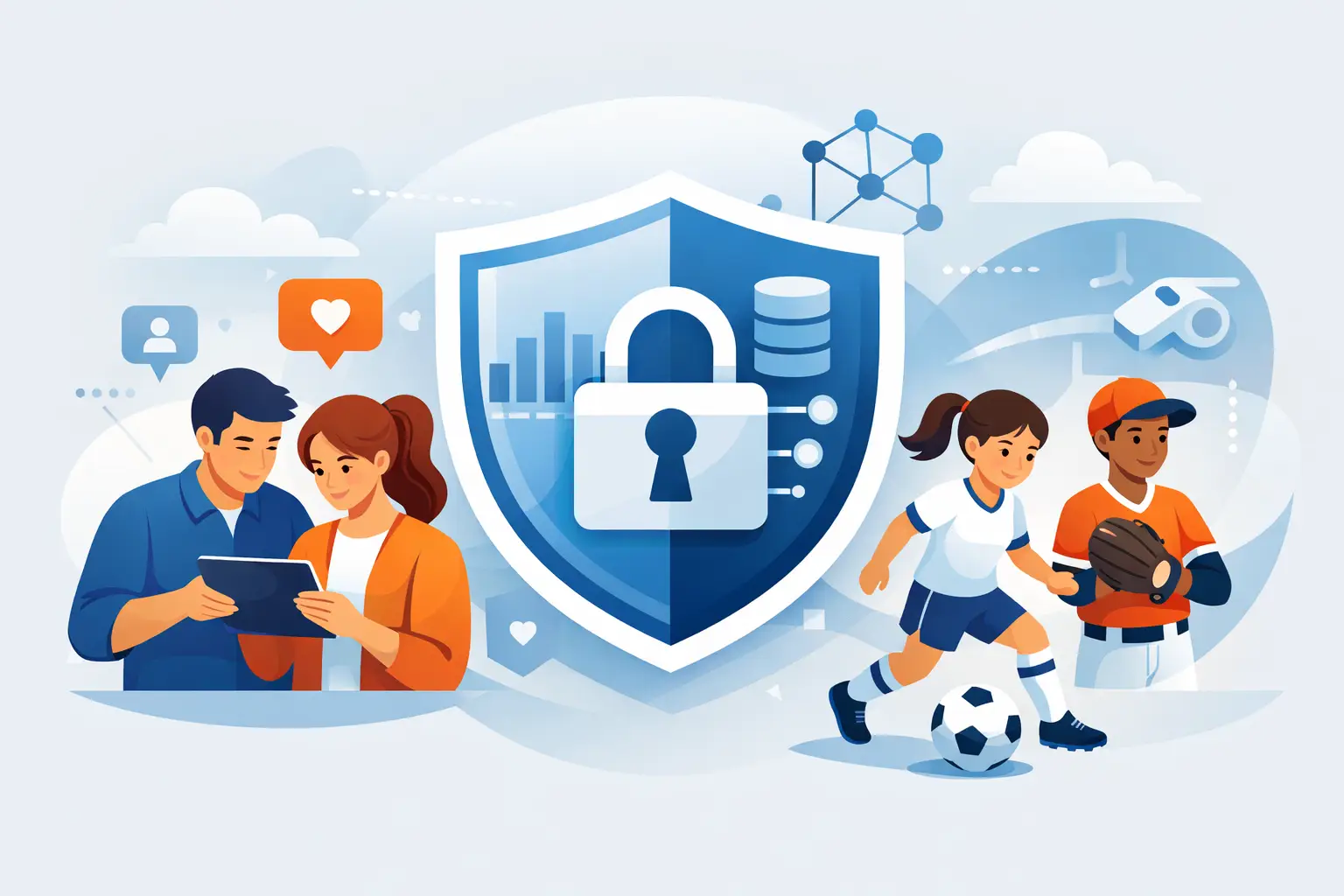
A private youth sports data app documents progress, supports coaching conversations, and keeps a young athlete’s development out of leaderboards and ranking pressure.
Youth sports is being consolidated. Not the leagues you watch on television, but the layer underneath: tournament operators, training academies, facility groups, recruiting networks, and the software platforms families are asked to log their children's development into. The investment case for that layer is not any single business. It is that they connect.
For a tennis parent, that is not an abstract observation about finance. It is a description of the apps on your phone.
What the pipeline actually runs on
Facilities and tournaments are the visible part. The connective tissue is data.
A development platform captures performance information. A tournament aggregates the families around it. A recruiting network monetizes that record later, downstream, to someone else. Each layer is worth more when it is joined to the others, and what joins them is a longitudinal file on a child: years of results, training volume, injuries, ratings, contact details, and the parents' own attention.
That file has a property most family data does not. It starts when a kid is eight and it does not stop. A season of results says little. Eight years of them, attached to a name, a birth year, a region, and a set of coaches, is a durable asset that gets more valuable the longer it runs.
Nobody presents it that way at sign-up. It is presented as a tool for you.
The law moved this year, and it tells you what regulators were seeing
The children's privacy rules changed in ways worth knowing.
The COPPA amendments took effect in June 2025, with a compliance deadline of April 2026. Two changes land directly on sports families. Biometric information, including face scans and voiceprints, joined the protected list, which matters for any app that asks you to film your child's serve. And operators now need separate parental consent before sharing a child's data with advertisers or with AI training systems. Not bundled into the terms you accepted at sign-up. Separate.
Enforcement is no longer theoretical. Penalties run to tens of thousands of dollars per violation per day, and recent settlements with large companies have landed in the eight figures.
Read that second change again, because it is the useful one. A rule requiring separate consent to feed children's data into AI training exists because that was happening under general consent language. The law is now the floor. "We are COPPA compliant" says a company meets the minimum. It says nothing about what it intends to do with your daughter's eight-year record.
The cost nobody puts on the invoice
There is a second reason to care, and it has nothing to do with data brokers.
Platforms that earn from tournament volume, travel circuits, and premium training do better when families do more of all three, earlier. Year-round specialization is not only a cultural drift. It is the behavior those economics reward.
The research on what that does to young athletes is not ambiguous. Burnout is associated with depression, anxiety, insomnia, and psychological distress, and the factors named most often are early specialization, overload, and adult over-involvement. Between ages 12 to 14 and 15 to 17, self-esteem and physical self-perception fall while social anxiety rises.
Comparison is a specific part of this. Among young athletes, passive use of social networks raised anxiety and lowered wellbeing, with upward social comparison doing much of the work in between. Passive use means scrolling. Watching other people's results.
So consider what a leaderboard inside a development app actually is. It is a machine for upward social comparison, pointed at a thirteen-year-old, at the age the research says self-perception is already falling. It is also an excellent engagement feature. Those two facts are why it keeps getting built and leveraged by many companies.
Design is a decision. Governance is what keeps it a decision.
Any company can write a good privacy policy. The harder question is what stops a good decision from being quietly reversed the year the growth numbers get difficult.
TierBreak's answer is a set of ten commitments ratified in an internal constitution in July 2026 and published. Among them: no leaderboards and no ranking one child against another as identity. No child-to-child messaging, friend graph, or public profile, with coach-to-family as the only cross-account channel. No searchable directory of children. No directory of other people's children: data about a player comes from the family or from an official, consented, per-user API, never scraped from someone else's database of minors; the trust page records the one dated change to that line. No storing or proxying your USTA or UTR passwords. No ads, and no selling, renting, or disclosing personal data.
The commitments matter less than the rule attached to them. A line is only ever removed by a later, dated, public change that names the line and the reason. Never quietly, and never as a side effect of a release.
That is the part worth holding any company to, including this one. A promise you can withdraw silently is a preference. A promise that costs you a dated public admission to withdraw is closer to a constraint. Ask whether the products your family uses have anything like it.
Four questions worth asking before you log anything
Who benefits when the record grows? If the answer is a recruiting marketplace, a rankings product, or an advertiser, the app's interests and your child's are not aligned, however good the interface is.
Can you get it out, and get it deleted? Both, on request, without a phone call, and not behind a paywall. If the export is difficult, the record is not really yours. Ours are both free and always will be.
What is the default comparison? Against other children, or against your own athlete six months ago? This is the most revealing question on the list, because it is a product decision that cannot be retrofitted.
What happens in an acquisition? Most privacy policies permit personal data to transfer as an asset in a sale. That is standard language, and it is worth reading carefully in a category being actively consolidated.
Records are good. Ownership is the question.
None of this is an argument against keeping one. A family with an honest record has better conversations with coaches, makes better decisions about the schedule, and gives a young athlete something to point at that is not a ranking.
It is an argument that a record about a child is a serious thing, and that who ends up holding it is worth asking on the way in rather than on the way out. Ask it early, ask it plainly, and be willing to walk away from a good interface attached to a bad answer.
The work belongs to your family. So should the record of it.
TierBreak is free on the App Store, on iPhone, iPad, and Mac. Want to work directly with the founder? Ask for an Inner Circle place.
Written by Thomas House, the tennis dad who built TierBreak. More from the blog.
The weekly guide for tennis parents
One email a week: the guide of the week and one post worth reading. Written by the tennis dad who built TierBreak. Unsubscribe in one click.