Blog / Post
September 12, 2026 · 7 min readJunior Tennis Parent-Coach Communication: What to Share
Junior tennis parent-coach communication improves when you share evidence, set clear boundaries, and give a coach access only to the right player data.
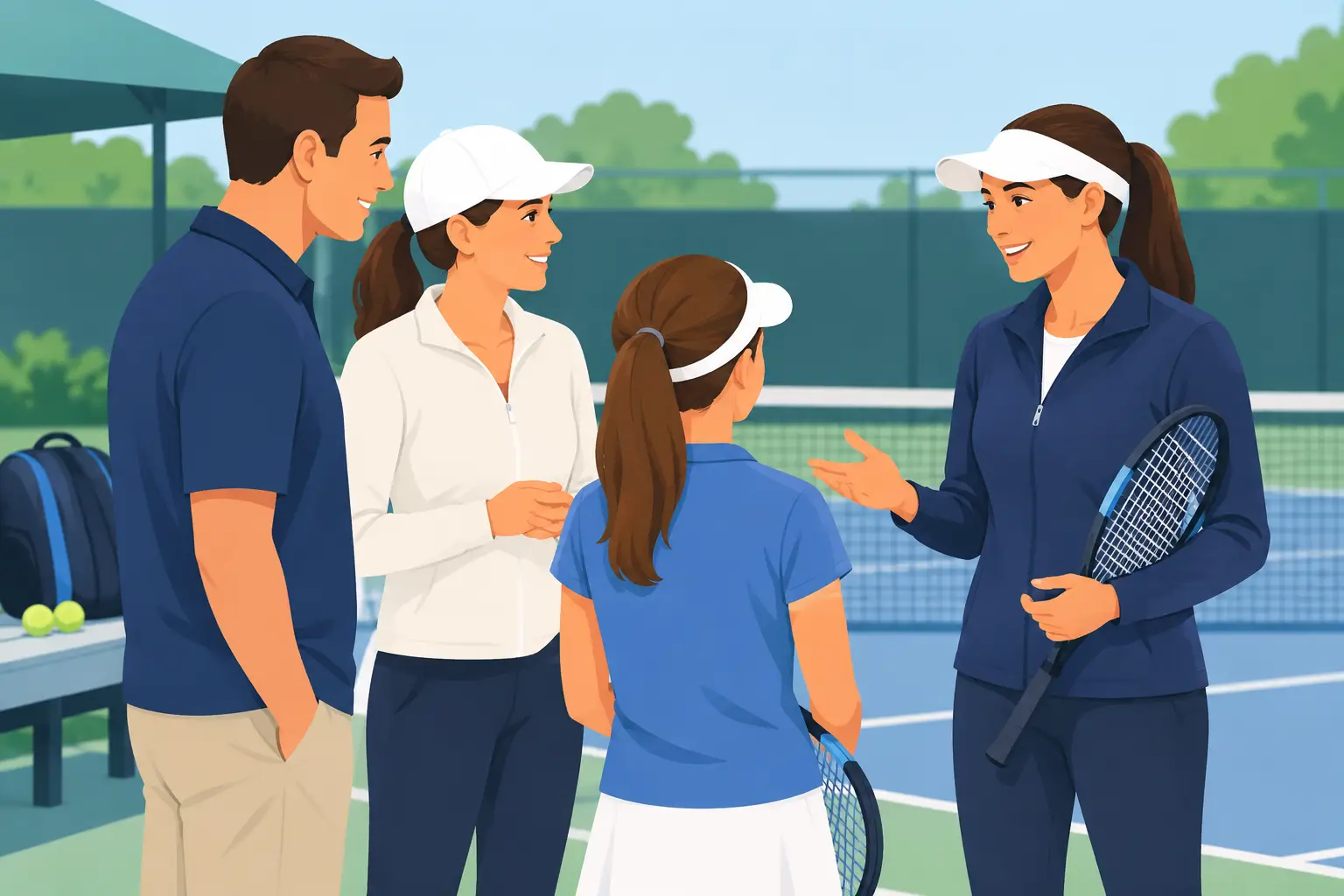
A coach can only work with the picture they can see. Whether a parent should be involved is not the open question. You already are. The open question is whether your involvement hands the coach useful evidence or one more layer of noise around the athlete.
Tournament weekends can make every result feel urgent. But a productive parent-coach relationship does not require a running report after every practice or a detailed explanation for every loss. It requires a clear lane: the parent brings context and consent, the coach brings instruction and judgment, and the athlete has room to learn without feeling watched from every angle.
Share the evidence that changes a coaching decision
The most useful information is not always the most emotional information. "She was frustrated" may be true, but it does not tell a coach what happened. "She was frustrated after missing short forehands at 30-30 twice in the second set" gives the coach a place to begin.
Before a lesson, share material that helps a coach prepare for the next decision. That might be a recent match result, the upcoming event schedule, a stated goal, or a pattern seen across several matches. If an athlete has tracked points, the coach may benefit from seeing a recurring leak: perhaps the second serve is producing too many short points, or a particular return pattern is not holding up under score pressure.
Context matters too. Let the coach know about a change that affects the work: a new school schedule, an upcoming tournament stretch, a confidence dip after a difficult match, or a goal the athlete has chosen. Keep the language concrete and proportionate. One rough afternoon does not establish a trend. Three similar matches over several weeks may.
A simple test helps: will this information change how the coach plans, teaches, or follows up? If the answer is no, it may belong in a family conversation rather than a coaching message.
What parents should not carry into every conversation
Parents often feel responsible for translating the athlete's entire experience. That is understandable. It can also prevent the athlete and coach from building the direct relationship that makes coaching work.
Avoid sending a coach a point-by-point emotional account immediately after a match. The athlete may need time before a lesson to form their own view. A parent's first interpretation can become the official story too quickly, especially when disappointment is still close.
It also helps to separate observations from conclusions. "He looked flat in the third set" is an observation. "He does not want to compete" is a conclusion that may not be supported by the evidence. Ask the coach a question instead: "Did you see anything in recent practice that might help explain his third-set energy?"
Do not use the coach as an arbiter of rankings, other children's progress, or whether your athlete is "ahead." Those comparisons create pressure without creating a next step. The useful standard is personal: is the athlete developing a clearer game, better habits, stronger decision-making, and a more complete record than before?
Give the athlete a voice before you give the coach a report
A junior tennis coaching relationship is stronger when the athlete is not discussed as a project in the room. That does not mean parents disappear. It means the athlete should have a fair chance to describe what they felt, noticed, and want help with.
Before contacting the coach, ask a few calm questions. What felt different in that match? What situation would you like to practice? What do you want your coach to know? Then listen without turning the car ride home into an immediate review.
This is especially valuable after a loss. The first useful response may be no analysis at all. Food, quiet, and a drive home can be enough. Later, the athlete may identify something more useful than a parent could have supplied: difficulty reading a wide serve, uncertainty on short balls, or a tendency to rush between points.
One match can produce two accounts, and they do not need to agree. The athlete may remember a brave return game; the parent may notice that the between-point routine disappeared late in the second set. Both can be accurate, because they were watching different things. Keeping the two separate is what protects the athlete's ownership of their own experience.
Tennis coach access to player data should have a purpose
A coach does not need unrestricted access to a family's information to coach well. Access should follow the question being answered.
If the coach is preparing for a lesson, recent training sessions, match results, goals, and an upcoming schedule may be relevant. If the coach is reviewing tactical patterns, derived point analysis may be useful. If a family wants the coach to understand where the athlete is in mental and emotional skills work, the coach may only need to know the phase, the step, and that the work happened.
The private writing itself is not coaching material. The athlete needs a place to be honest without wondering whether every sentence will be read by an adult outside the family. A thirteen-year-old who knows her coach can read her journal will write something safe, and the safe version is worth nothing to anybody.
This distinction is not administrative detail. It changes the quality of the relationship. A coach who receives focused information can prepare better. An athlete who knows the boundaries can participate more openly. A parent who controls access can support the process without handing over the family's entire record.
TierBreak is built around this kind of named access. A family can grant a coach specific areas for a specific athlete: training sessions, match results, goals clocks, upcoming schedule, derived point analysis, and mental-pathway progress. Access can be withdrawn. One pairing is enforced rather than offered: point analysis requires match access, because grouping points by opponent and date would reveal the results themselves through a side door. A grant that tried to separate them would be a boundary in name only.
Establish a communication rhythm before a problem appears
Many parent-coach relationships become strained because the rules are invented in the middle of disappointment. Set expectations when things are calm.
Ask the coach how they prefer to receive updates. Some coaches want a short note before a lesson. Others prefer to speak with the athlete first and receive only major schedule or goal changes from a parent. Neither approach is automatically better. It depends on the athlete's age, the coach's role, the frequency of lessons, and how much competition is happening.
Agree on what requires prompt communication. Tournament withdrawals, schedule changes, and a significant shift in the athlete's goals may need a message. A single bad practice usually does not. Clarify whether parents should stay after lessons for a brief check-in, send a weekly update, or reserve questions for scheduled conversations.
Keep messages short enough to be used. A coach preparing for several athletes does not need a family history in a text thread. Try: "Two matches this weekend. Her own takeaway was that she struggled to return the wide serve. Could you spend a few minutes on first-ball return position this week?" That is respectful of the coach's time and clear about the request.
Use data to ask better questions, not to prosecute a case
Match data can bring clarity, but it can also become a source of pressure when adults treat every number as a verdict. A small sample can suggest a question. It cannot always establish an answer.
If one match shows a high number of unforced errors, ask what was happening around those errors. Were they concentrated on one shot? Did they appear late in rallies? Did they rise on break points, which the app takes from the score itself? Was the athlete facing a stronger opponent or trying a newly learned pattern? The numbers should lead back to instruction, not blame.
The same restraint applies to improvement. A better serving day is encouraging. It is not proof that the issue is solved. Look for changes across enough matches and training sessions to make a useful coaching decision. When the evidence is thin, say that plainly.
This is where a private, personal record beats a public comparison system. Whether an athlete's backhand looks better than another child's answers nothing you can coach. Whether that athlete is handling more of their own backhand pressure than they did last month is a practice plan.
Protect the relationship that makes improvement possible
The best parent-coach communication reduces confusion. It does not turn the parent into a second coach, the coach into a scorekeeper of family anxiety, or the athlete into a set of statistics.
Share what is timely, specific, and actionable. Let the athlete speak first when possible. Give a coach only the information needed for the work. Keep private reflection private. Then allow enough time for a pattern to become visible.
A good record can make the next conversation calmer: not "What went wrong?" but "What changed, and what should we work on next?" That is a question an athlete can grow with.
TierBreak is free on the App Store, on iPhone, iPad, and Mac. Want to work directly with the founder? Ask for an Inner Circle place.
Written by Thomas House, the tennis dad who built TierBreak. More from the blog.
The weekly guide for tennis parents
One email a week: the guide of the week and one post worth reading. Written by the tennis dad who built TierBreak. Unsubscribe in one click.